GEO: Generative Engine Optimisation — The New Rules of Search Visibility in 2026
Introduction
There’s a quiet revolution happening every time someone types a question into ChatGPT, Perplexity, or Google’s AI Overviews. They’re not getting a list of ten blue links anymore. They’re getting a direct, synthesised answer — and your brand is either part of that answer or it isn’t.
This is the world that gave birth to Generative Engine Optimisation (GEO) — and if you’re still playing purely by the old SEO rulebook, you’re optimising for a search engine that a growing share of your audience has already moved past.
What Exactly Is GEO?
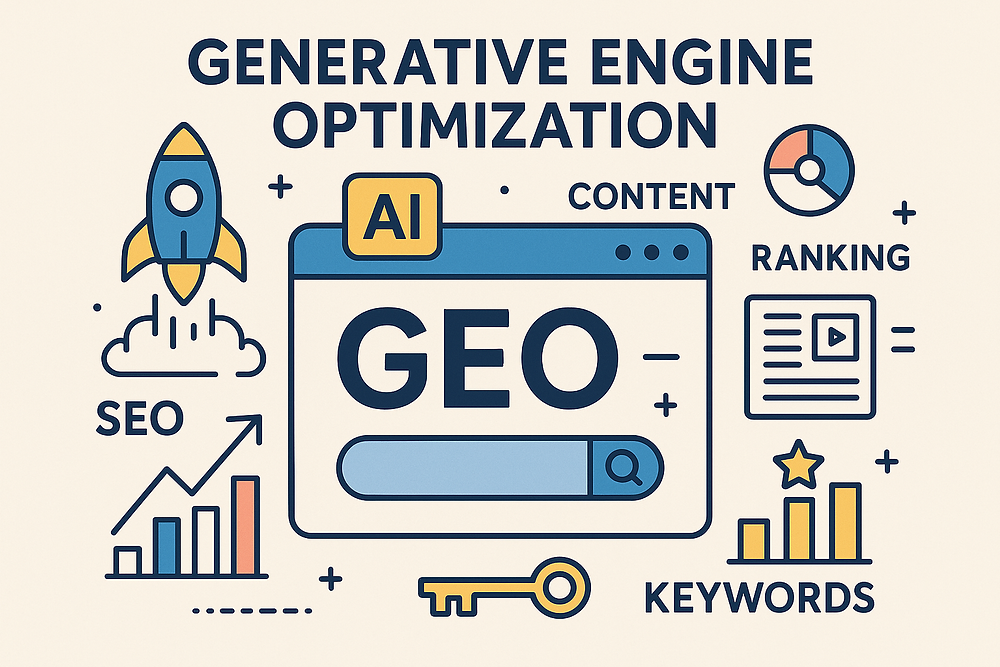
Generative Engine Optimisation (GEO) is the practice of optimising your content to be cited as a trusted, authoritative source inside AI-generated responses — on platforms like ChatGPT, Perplexity, Google AI Overviews, Bing Copilot, and Claude.
You may also hear it called AI SEO, Answer Engine Optimisation (AEO), or Large Language Model Optimisation (LLMO). The industry hasn’t fully settled on a single name — but every term describes the same goal: get your content cited by AI.
The key difference from traditional SEO? The goal is no longer to earn a click. It’s to have your information included in the answer itself.
Why GEO Matters: The Numbers Don’t Lie
The urgency around GEO becomes undeniable when you look at the data:
- ChatGPT processes 2.5 billion prompts daily — and 65% of them qualify as search queries.
- AI-referred sessions jumped 527% year-over-year in the first five months of 2025 alone.
- AI Overviews have reduced click-through rates for top-ranking Google content by 58% — because users get their answer without ever leaving the page.
- The overlap between top Google-ranked links and AI-cited sources has dropped from 70% to below 20% — meaning ranking #1 on Google no longer guarantees being cited by AI.
That last stat is the most striking. A page can rank #1 in Google’s traditional results and still be completely invisible inside an AI-generated answer. The algorithms are operating on different logic.
GEO vs. SEO: A Side-by-Side Breakdown
| Traditional SEO | GEO | |
|---|---|---|
| Goal | Rank on search results pages | Get cited in AI-generated answers |
| Success Metric | Rankings, clicks, traffic | AI mentions, citations, brand visibility |
| Key Signals | Keywords, backlinks, page speed | Authority, EEAT, structured content |
| User Journey | User clicks → visits your site | User reads AI answer → absorbs your brand |
| Traffic Model | High CTR from top positions | Lower traffic, but higher intent & trust |
| Content Format | Keyword-optimised pages | Clear, extractable, structured insights |
The fundamental shift: Traditional SEO optimises for visibility in search results. GEO optimises for inclusion in the answer itself.
How Generative AI Actually Sources Information
To win at GEO, you need to understand how LLMs find and use your content. It’s not a simple keyword match.
When a user asks a question, here’s what typically happens:
1. Query Fan-Out The AI breaks the question into multiple sub-queries. If someone asks “What’s the best project management tool for remote teams?” the AI might separately search for “best project management tools 2026,” “remote team collaboration software,” and “project management pricing comparison.”
2. Multi-Source Synthesis Unlike Google giving you a ranked list, LLMs pull from multiple sources and synthesise a single coherent answer. Your content competes not just for attention but for trustworthiness in the AI’s evaluation.
3. Trust & Authority Scoring AI systems build a trust score for your brand based on how clearly and consistently you appear across the web — on your website, LinkedIn, industry directories, Crunchbase, third-party mentions, and credible backlinks. A brand that’s invisible outside its own website is a brand the AI will hesitate to cite.
The 5 Pillars of a Strong GEO Strategy
1. EEAT — Experience, Expertise, Authoritativeness, Trustworthiness
This isn’t new — Google introduced EEAT as part of its quality guidelines years ago. But in the age of GEO, it’s the single most important framework to build around.
AI engines are looking for content that signals real expertise. That means:
- Named authors with verifiable credentials
- First-hand experience, original data, and case studies
- Consistent, accurate information across all your web presence
- Strong external references and citations pointing to your content
2. Structured, Extractable Content
LLMs love content they can parse and reference easily. Use clear headings, concise answers near the top of sections, bullet points for listicles, and FAQ-style formats for common questions. Think of it less like writing an essay and more like building a well-labelled knowledge base.
JSON-LD structured data has moved from a “nice-to-have” to a foundational requirement — it’s increasingly the bridge between your website and AI retrieval systems.
3. Entity Optimisation & Topical Authority
AI engines don’t just understand keywords — they understand entities (specific things: people, places, concepts, organisations). Your brand needs to exist clearly as a trusted entity across the web.
Build topical authority by creating interconnected content ecosystems rather than isolated blog posts. AI rewards breadth and depth on a subject, not just a single well-optimised page.
4. AI Crawler Accessibility
This one trips up many brands. Before anything else, AI systems need to be able to read your pages. Check your robots.txt file — many sites are inadvertently blocking AI crawlers. Tools like Cloudflare have even changed default configurations to block AI bots, meaning your content may already be invisible to ChatGPT and Perplexity without you knowing.
5. Off-Site Brand Presence
AI systems have a trust score for your brand that’s built from what exists beyond your own website. A strong GEO footprint means being consistently present and accurately described on:
- LinkedIn and other social platforms
- Wikipedia or Wikidata (for larger brands)
- Crunchbase, G2, Clutch, and industry-specific directories
- Third-party news coverage and authoritative backlinks
GEO Metrics: What to Track
Since GEO isn’t about clicks and rankings in the traditional sense, you need new metrics:
- AI Mention Frequency — How often is your brand cited in AI responses for your target queries?
- AI Share of Voice — How do you compare to competitors in AI-generated answers?
- Brand Sentiment in AI Responses — Is AI describing your brand accurately and positively?
- AI-Referred Traffic — Sessions originating from clicks within AI platforms (trackable via UTM and analytics)
- Conversion Intent from AI Traffic — AI-referred traffic often converts at significantly higher rates than traditional search
Tools like Semrush’s Enterprise AIO now offer granular tracking of AI mentions, sentiment, and competitive benchmarking across ChatGPT, Google AI Overviews, and Perplexity.
GEO in Practice: A Simple Audit to Start Today
Step 1 — The AI Summary Test Open ChatGPT or Perplexity and search for the questions your target audience asks. Is your brand mentioned? If not, who is? This tells you who has the GEO advantage right now.
Step 2 — The Accuracy Check Ask these AI platforms to describe your brand, products, or services. Are the summaries accurate? Inaccurate AI representations signal that your content lacks the structured clarity AI needs to cite you confidently.
Step 3 — The Crawler Check Audit your robots.txt for AI bot restrictions. Tools like LLMrefs can help you test how accessible your content is to the most common AI crawlers.
Step 4 — Content Gap Analysis Map the queries where you want to appear in AI answers. For each one, ask: does your website have clear, structured, authoritative content that directly addresses it? If not, that’s a GEO content gap.
Is SEO Dead? No — But It Has Evolved
Let’s put this clearly: GEO doesn’t replace SEO. It’s what SEO grows into.
Traditional SEO fundamentals — a fast, mobile-friendly website, clean site structure, quality backlinks, and high-value content — are still the foundation. You still want to rank in the traditional “blue links.” But you now also need to optimise for how AI models interpret, synthesise, and surface your information.
The brands that will dominate the next chapter of search are those that build both in parallel — maintaining their traditional SEO presence while engineering genuine authority for the AI era.
The Bottom Line
Search is undergoing its most fundamental transformation since Google indexed its first web page. The window to get ahead of this shift is open right now — because most of your competitors are still focused entirely on the old game.
The brands and marketers who figure out GEO in 2026 won’t just maintain visibility — they’ll become the trusted sources that AI recommends to millions of users who never even visit their website.
Old SEO asked: “Can I rank #1 for this keyword?” GEO asks: “Will the AI trust my content enough to cite it?”
That’s a different game entirely — and the starting gun has already fired.